
ISO 9223 Corrosivity Categories (C1–CX) for HVAC
How the categories are defined
ISO 9223 classifies an atmosphere by the first-year corrosion rate of standard samples of carbon steel, zinc, copper and aluminium. Where no exposure test is available, the standard estimates the category from four environmental factors — temperature, relative humidity, sulphur dioxide deposition and chloride deposition.
| Category | Corrosivity | Carbon steel, first-year loss | Typical outdoor examples |
|---|---|---|---|
| C1 | Very low | ≤ 1.3 μm | Dry or cold regions, very low pollution |
| C2 | Low | 1.3–25 μm | Dry inland, rural areas |
| C3 | Medium | 25–50 μm | Urban, light industry, coast with low salt |
| C4 | High | 50–80 μm | Industrial areas, coastal sites with moderate salt |
| C5 | Very high | 80–200 μm | Heavy industry, humid coast with high salt |
| CX | Extreme | 200–700 μm | Offshore, sea spray, extreme industrial exposure |
Related standards
ISO 9224 gives guiding long-term corrosion rates for each category, ISO 9225 covers how the environmental factors are measured, and ISO 9226 covers how the metal samples are exposed and evaluated. ISO 12944 uses the same C1–CX categories to specify paint systems for structural steel.
From category to coating
Coil fins and tubes have very little metal to lose, and the fin-to-tube joint on copper-tube coils corrodes faster than either metal alone. A category is therefore a starting point: adjust for unit height and exposure, humidity, local pollution and the coil type before choosing the system.
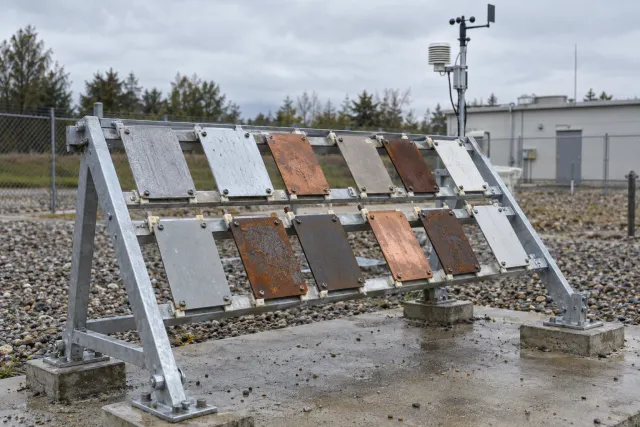
ISO 9223 corrosivity category
Typical category for this environment: C1–CX.
- C1Very low
- C2Low
- C3Medium
- C4High
- C5Very high
- CXExtreme
Recommended protection by category
| Condition | ISO 9223 | Recommended system | Note |
|---|---|---|---|
| Urban, light industry, far from the sea | C3 | PG-W Waterborne 2K | Coating optional in dry climates; recommended where humid. |
| Coastal 0.5–5 km, industrial areas | C4 | PG-S1 Polysiloxane sol-gel | Thin film applied by dip before installation. |
| Shoreline, heavy industry, humid coast | C5 | PG-S1 Polysiloxane sol-gel | PG-C where acid gases or chemical splash are present. |
| Direct sea spray, offshore, severe industry | CX | PG-C Air-dry 2K | Review the site before specifying; thin film alone is not enough. |
Not sure which category your site falls into?
Enter distance from the sea, humidity and nearby industry to get an estimated ISO 9223 category.
Related
- CoatingsWaterborne Polysiloxane (Sol-Gel) Coil Coating
- EquipmentCopper Tube, Aluminium Fin Coil Protection
- EnvironmentsCoastal HVAC Corrosion by Distance from the Sea
- StandardsISO 12944 and What It Means for HVAC Coils
- GuidesHow to Select a Coil Coating for Your Project
- ToolsSite Corrosivity Estimator
Also see
- CoatingsWaterborne Two-Component Coil Coatings
- EquipmentCondenser Coil Anti-Corrosion Coating
- EnvironmentsIndustrial Atmospheres (SO₂, NOx, Chlorides)
- GuidesHow Far from the Sea Do HVAC Coils Need Corrosion Protection?
- CoatingsAir-Dry Two-Component Chemical-Resistant Coating
- EquipmentMicrochannel Coil Corrosion Protection

Does ISO 9223 apply to HVAC coils?
It classifies the atmosphere, not the equipment, so it applies to any metal outdoors. Coils are more sensitive than structural steel because their metal is so thin, which is why coil specifications usually aim one step above what steelwork would need.
How do I find my site's category without a year of testing?
An estimate from distance to the sea, humidity, pollution and shelter is enough for most coating decisions. Use the corrosivity estimator, then confirm with local data where it exists.
Tell us the equipment, the site and the destination port. We reply within 24 hours.