
Copper Tube, Aluminium Fin Coil Protection
Where it corrodes first
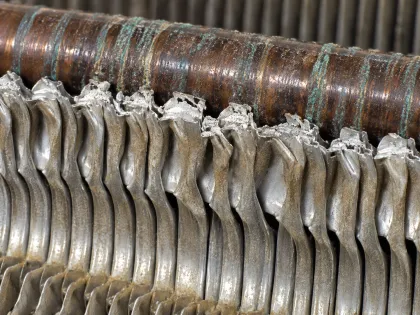
Fin-to-tube joints
Copper and aluminium touch at every fin collar. Once an electrolyte film forms, the aluminium corrodes and the fin loses contact with the tube.
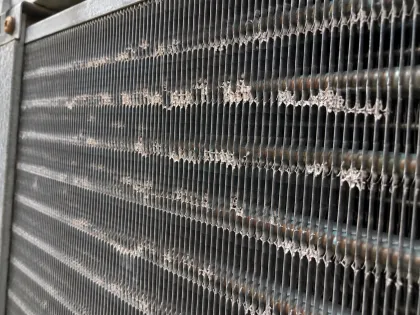
Leading fin edges
Air enters the coil here first, carrying salt and dust. Cut fin edges have no protective layer and pit first.
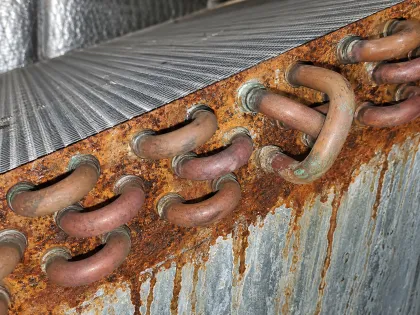
Return bends and brazed joints
Hairpins, headers and brazed joints collect moisture and deposits, and are hard to reach with spray.
Illustrative images of typical corrosion at each location
Recommended system by exposure
Starting point for selection. The final specification also depends on fin density, bake limits and target service life.
| Exposure | ISO 9223 | Recommended | Alternative | Why |
|---|---|---|---|---|
| Coastal | C4C5 | PG-S1 | PG-W | Thin film applied by dip before shipment keeps heat-transfer loss low. |
| Tropical humid | C3C4 | PG-W | PG-S1 | Coil-line application for mild coastal and humid sites. |
| Industrial atmosphere | C4C5 | PG-S1 | PG-C | Move to PG-C where acid gases or chemical splash are present. |
| Wastewater H₂S | C5 | PG-C | — | Sulphide attacks copper quickly; a thicker chemical-resistant film is needed. |
| Complete outdoor unit (cannot be baked) | PG-C | PG-S1 | Air-dry cure; PG-S1 only with ambient moisture cure. |
How it is coated
Dip Coating for Finned Heat Exchangers
Full-immersion dip coating for new finned coils — coverage deep in the core and at the fin roots, with film thickness controlled by drain-off.
Spray Coating for HVAC Coils
Spray coating for coils that are too large to dip, already assembled, or need a thicker chemical-resistant film on specific areas.
Full-Unit Corrosion Protection for Outdoor Units
Complete outdoor units disassembled, masked, coated with an air-dry system, reassembled and function-checked before shipment.
Pre-Shipment Coil Coating in China
HVAC coils and outdoor units sourced from China, coated on partner lines before loading — coating selected for site corrosivity, with a batch QC report.
Why Cu-Al coils fail the way they do
Round-tube, plate-fin coils — also called RTPF or fin-and-tube coils — put two metals in permanent contact. Dry, the pair is stable. Once salt, dust or pollutants form a thin conductive film, the aluminium fin corrodes preferentially at the collar around each tube.
The first sign is white corrosion product on the fins. By the time fins flake or can be pushed off the tube, contact between fin and tube is already lost and the coil delivers less capacity at the same airflow.
Coating works by keeping the electrolyte film off both metals. That is why coverage at the fin roots and collars matters more than film thickness on the flat fin faces.
Related
- CoatingsWaterborne Polysiloxane (Sol-Gel) Coil Coating
- EnvironmentsCoastal HVAC Corrosion by Distance from the Sea
- ComparisonsCoated Cu-Al Coils vs Copper-Fin Coils
- GuidesWhat Coating Is Best for Coastal HVAC Coils?
- CoatingsWaterborne Two-Component Coil Coatings
- EnvironmentsTropical High-Humidity Environments
Also see
- GuidesDoes Coil Coating Reduce Heat Transfer?
- CoatingsAir-Dry Two-Component Chemical-Resistant Coating
- EnvironmentsIndustrial Atmospheres (SO₂, NOx, Chlorides)
- GuidesCan Coated Coils Be Brazed or Repaired Afterwards?
- EnvironmentsFormicary (Ant-Nest) Corrosion in Copper Tubes
- GuidesWhy Do Coil Copper Tubes Develop Pinhole Leaks?

Why does the aluminium corrode before the copper?
In a salty moisture film aluminium is anodic to copper, so the fin gives up metal to protect the tube. Isolating both metals with a continuous film breaks that cell.
Are copper-fin coils a better answer?
Copper fins remove the copper–aluminium couple but cost more and still corrode in sulphide atmospheres. Compare both options for your site before deciding.
Tell us the equipment, the site and the destination port. We reply within 24 hours.