
Microchannel Coil Corrosion Protection
Where it corrodes first
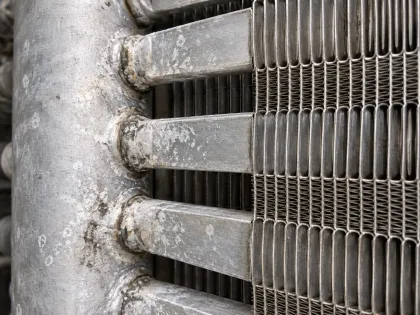
Tube-to-header brazed joints
Braze alloy and flux residue sit next to the thin tube wall. Corrosion that starts here reaches the refrigerant side quickly.
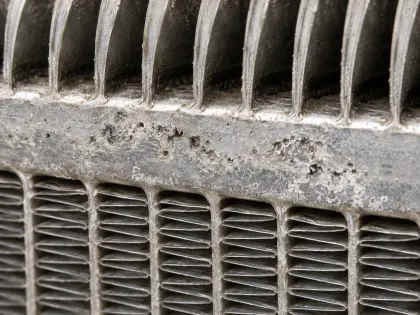
Thin flat tubes
Pitting on the flat tube face does not need to spread far — it only has to go through a wall far thinner than a round copper tube.
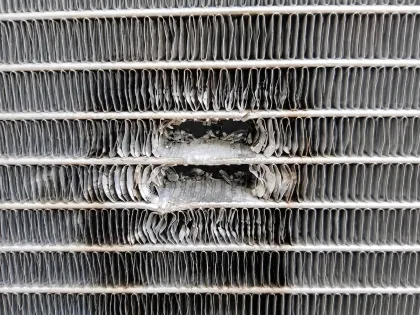
Louvered fins on the inlet face
The fine louvers catch salt and dust first. Once corroded they break away, and the coil loses capacity even before it leaks.
Illustrative images of typical corrosion at each location
Recommended system by exposure
Starting point for selection. The final specification also depends on fin density, bake limits and target service life.
| Exposure | ISO 9223 | Recommended | Alternative | Why |
|---|---|---|---|---|
| Coastal | C4C5 | PG-S1 | PG-W | Dip-applied thin film reaches the louvers without closing them. |
| Tropical humid | C3C4 | PG-W | PG-S1 | Coil-line application for mild coastal and humid sites. |
| Desert heat, sand and salt | C4C5 | PG-S1 | — | Hard thin film; clean with low-pressure water only. |
| Industrial atmosphere | C4C5 | PG-S1 | — | Thick-film systems risk bridging the louvers; review the fin geometry before specifying one. |
How it is coated
Dip Coating for Finned Heat Exchangers
Full-immersion dip coating for new finned coils — coverage deep in the core and at the fin roots, with film thickness controlled by drain-off.
Pre-Shipment Coil Coating in China
HVAC coils and outdoor units sourced from China, coated on partner lines before loading — coating selected for site corrosivity, with a batch QC report.
OEM Contract Coating for Coil Manufacturers
Contract dip and spray coating for coil and unit manufacturers — coating to your specification on partner lines in South China, with batch records.
Why microchannel coils fail differently
A round-tube coil corrodes at the fin collars and slowly loses capacity. A microchannel coil has flat multi-port tubes with walls much thinner than a copper tube, brazed to aluminium headers and louvered fins. In salt air the failure is a pinhole leak, and a leak ends the coil’s life.
Brazing leaves flux residue at the joints, and the braze alloy is electrochemically different from the tube. These joints are where most microchannel coils start to corrode.
What a coating has to do here
The film has to wet every louver and joint without filling the gaps between louvers. That points to a thin system applied by dip, drained and cured under control. Thick films give more barrier but add air-side pressure drop on fine louvers, and are only used after the fin geometry has been reviewed.
Related
- CoatingsWaterborne Polysiloxane (Sol-Gel) Coil Coating
- EnvironmentsCoastal HVAC Corrosion by Distance from the Sea
- ComparisonsThin-Film vs Thick-Film Coil Coatings
- GuidesWhich Coatings Work on Microchannel Coils?
- CoatingsWaterborne Two-Component Coil Coatings
- EnvironmentsDesert Heat, Sand and Salt: Gulf Region HVAC

Can a leaking microchannel coil be repaired?
Rarely. Leaks in the flat tubes are difficult to braze in the field, which is why protection before installation matters more than for round-tube coils.
Does coating block the louvers?
Not with a thin film applied by dip and drained correctly. Film thickness and bridging are checked on both coil faces for every batch.
Is spray coating an option?
Spray reaches the inner louvers poorly on deep microchannel coils. Dipping is preferred wherever the coil fits the tank.
Tell us the equipment, the site and the destination port. We reply within 24 hours.