
VRF and Split Outdoor Unit Protection
Where it corrodes first
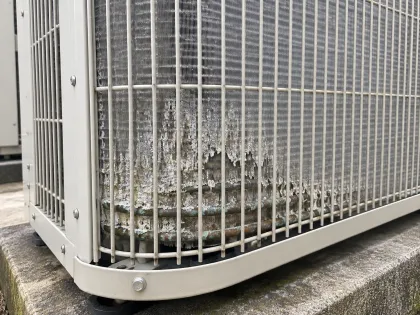
Condenser coil faces
The outdoor coil takes most of the salt and dust drawn in by the fan.
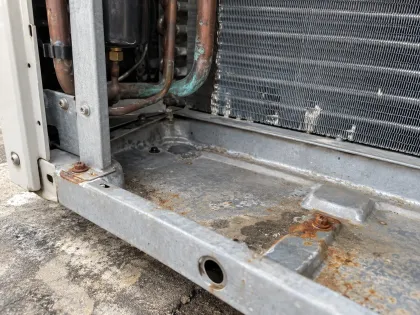
Base pan and fasteners
Water and debris collect in the base pan; steel fasteners in contact with aluminium corrode galvanically.
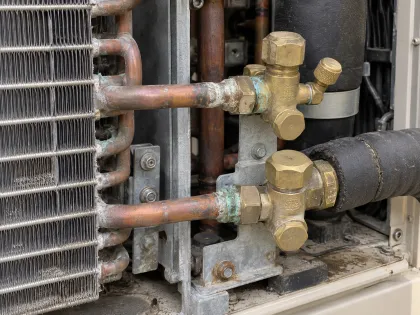
Tube connections and service valves
Brazed joints, flare nuts and valves near the base are wet for long periods and hard to reach.
Illustrative images of typical corrosion at each location
Recommended system by exposure
Starting point for selection. The final specification also depends on fin density, bake limits and target service life.
| Exposure | ISO 9223 | Recommended | Alternative | Why |
|---|---|---|---|---|
| Coastal, complete unit | C4C5 | PG-C | PG-S1 | Air-dry cure after masking; PG-S1 only with ambient moisture cure. |
| Coastal, coil removed | C4C5 | PG-S1 | PG-W | Coil dipped and cured on its own, then refitted and pressure-checked. |
| Desert heat, sand and salt | C4C5 | PG-C | PG-S1 | |
| Tropical humid | C3C4 | PG-W | PG-S1 | |
| Industrial atmosphere | C4C5 | PG-C | — |
How it is coated
Full-Unit Corrosion Protection for Outdoor Units
Complete outdoor units disassembled, masked, coated with an air-dry system, reassembled and function-checked before shipment.
Dip Coating for Finned Heat Exchangers
Full-immersion dip coating for new finned coils — coverage deep in the core and at the fin roots, with film thickness controlled by drain-off.
Spray Coating for HVAC Coils
Spray coating for coils that are too large to dip, already assembled, or need a thicker chemical-resistant film on specific areas.
Pre-Shipment Coil Coating in China
HVAC coils and outdoor units sourced from China, coated on partner lines before loading — coating selected for site corrosivity, with a batch QC report.
Two routes for complete units
Coil removed. The coil is taken out of the unit, dipped, cured in the oven and refitted. The refrigerant circuit is opened and closed again, so the unit is pressure-checked afterwards.
Complete unit. Panels are removed, the controls, sensors, valves and connections are masked, and the coil and exposed metal are coated with an air-dry system. The refrigerant circuit is not opened.
Which route applies is decided from the unit model, quantity and site category at the specification stage.
Related
- CoatingsAir-Dry Two-Component Chemical-Resistant Coating
- EnvironmentsCoastal HVAC Corrosion by Distance from the Sea
- GuidesHow Are Electrical Components Protected During Coating?
- CoatingsWaterborne Polysiloxane (Sol-Gel) Coil Coating
- EnvironmentsDesert Heat, Sand and Salt: Gulf Region HVAC
- GuidesCan New Imported Units Be Coated Before Installation?
Also see

Are the control boards coated?
No. The control box and boards are masked and left uncoated. Ask the unit manufacturer whether a factory conformal-coated board option is available.
Which route is better, coil removed or complete unit?
Removing the coil allows dipping and oven cure, which gives the best coverage. Complete-unit coating avoids opening the refrigerant circuit and is faster.
Tell us the equipment, the site and the destination port. We reply within 24 hours.