
Generator and Industrial Radiator Coating
Where it corrodes first
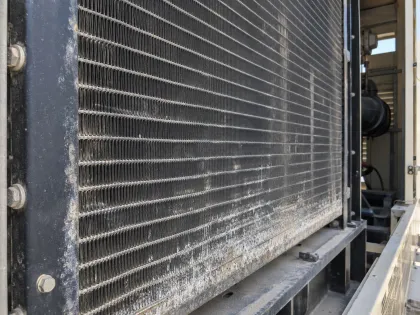
Core face on the fan side
Radiator fans move large air volumes through the core, depositing salt and dust on the air inlet face.
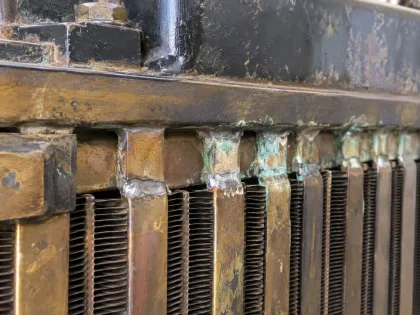
Tube-to-header joints
Brazed or soldered joints corrode first and are where coolant leaks start.
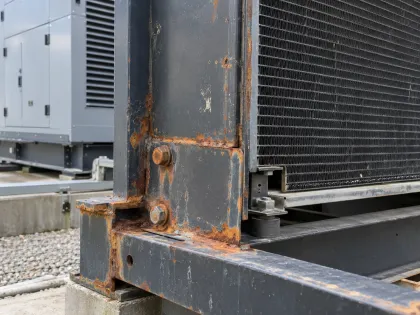
Side plates and frames
Steel frames in contact with aluminium or copper cores corrode at the contact points.
Illustrative images of typical corrosion at each location
Recommended system by exposure
Starting point for selection. The final specification also depends on fin density, bake limits and target service life.
| Exposure | ISO 9223 | Recommended | Alternative | Why |
|---|---|---|---|---|
| Coastal standby generators | C4C5 | PG-S1 | PG-S2 | PG-S2 only on all-aluminium cores that can be baked. |
| Desert and dusty sites | C3C4 | PG-S1 | — | Clean with low-pressure water only. |
| Mining and heavy industry | C5 | PG-C | PG-S1 | |
| Copper-brass cores | PG-S1 | PG-C | PG-S2 is not used on copper-containing cores. |
How it is coated
Dip Coating for Finned Heat Exchangers
Full-immersion dip coating for new finned coils — coverage deep in the core and at the fin roots, with film thickness controlled by drain-off.
Spray Coating for HVAC Coils
Spray coating for coils that are too large to dip, already assembled, or need a thicker chemical-resistant film on specific areas.
OEM Contract Coating for Coil Manufacturers
Contract dip and spray coating for coil and unit manufacturers — coating to your specification on partner lines in South China, with batch records.
Why radiators need protection
A generator radiator is sized for the engine’s full load, often with little margin. Corrosion that blocks or perforates the core reduces cooling exactly when the set is needed — during an outage.
Aluminium or copper-brass
Modern radiators are often brazed aluminium; older and heavy-duty designs use copper-brass cores. PG-S2 is a baked clearcoat for aluminium and stainless steel and is not used on copper-containing cores. PG-S1 is confirmed on both copper and aluminium.
Related
- CoatingsWaterborne Polysiloxane (Sol-Gel) Coil Coating
- EquipmentDry Cooler Coil Coating
- EnvironmentsCoastal HVAC Corrosion by Distance from the Sea
- GuidesDoes Coil Coating Reduce Heat Transfer?
- CoatingsBaked Polysiloxane-Urethane Clearcoat
- EnvironmentsDesert Heat, Sand and Salt: Gulf Region HVAC
Also see

Why not coat the radiator after installation?
It can be done by spray, but coverage inside the core is poorer and the site may be remote. Dipping the core before the set ships gives the best result.
Does coating affect engine cooling?
A thin film adds little thermal resistance. Specify a film range and ask for heat-transfer data; thick films on dense cores need more care.
Tell us the equipment, the site and the destination port. We reply within 24 hours.