
AHU Coil Coating
Where it corrodes first
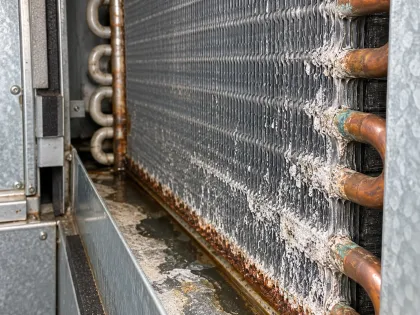
Cooling coil face on the fresh-air side
Outdoor air reaches the coil after only particle filtration, so salt and gases deposit on the first rows.
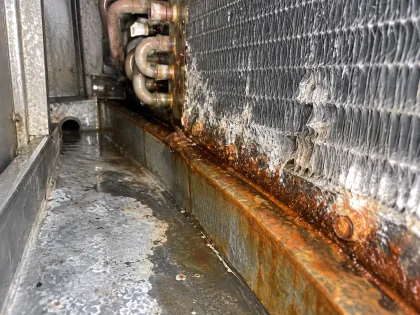
Condensate zone and drain pan side
The lower part of a cooling coil stays wet for long periods and collects deposits.
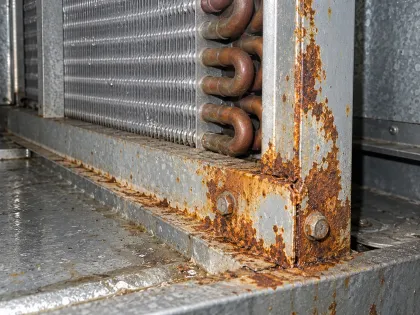
Coil frames and casings
Galvanised steel frames in contact with aluminium fins and copper headers corrode at the joints.
Illustrative images of typical corrosion at each location
Recommended system by exposure
Starting point for selection. The final specification also depends on fin density, bake limits and target service life.
| Exposure | ISO 9223 | Recommended | Alternative | Why |
|---|---|---|---|---|
| Coastal fresh-air units | C4C5 | PG-S1 | PG-W | Thin film applied by dip keeps condensate draining. |
| Tropical humid intake air | C3C4 | PG-W | PG-S1 | |
| Industrial or urban polluted air | C4C5 | PG-S1 | PG-C | |
| Indoor pool halls and dehumidifiers | C4C5 | PG-C | — | Chloramines in pool air need a chemical-resistant film. |
How it is coated
Dip Coating for Finned Heat Exchangers
Full-immersion dip coating for new finned coils — coverage deep in the core and at the fin roots, with film thickness controlled by drain-off.
Spray Coating for HVAC Coils
Spray coating for coils that are too large to dip, already assembled, or need a thicker chemical-resistant film on specific areas.
OEM Contract Coating for Coil Manufacturers
Contract dip and spray coating for coil and unit manufacturers — coating to your specification on partner lines in South China, with batch records.
Why indoor coils corrode
A cooling coil runs below the dew point, so it is wet whenever it is cooling. When the unit handles outdoor air, whatever that air carries — salt aerosol, sulphur compounds, humidity — ends up dissolved in the water film on the fins.
Drainage comes first
The coating must not stop condensate from running off the fins. Thin films applied by dip and checked for bridging keep drainage close to that of an uncoated coil. Thick films and bridged fins hold water and can raise carry-over at higher face velocities.
Related

Do recirculation-only AHUs need coated coils?
Usually not, unless the building air carries chemicals, chloramines or high humidity. The case for coating is strongest where the unit handles outdoor or process air.
Can heating coils be coated too?
Yes, but they run dry and warm, so they are less exposed than cooling coils. Coat them where the intake air is salty or polluted.
Tell us the equipment, the site and the destination port. We reply within 24 hours.