
Evaporator Coil Coating
Where it corrodes first
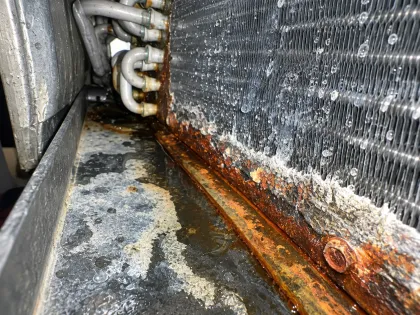
Lower fin area and drain side
Condensate runs down the fins and collects at the bottom of the coil, which stays wet the longest.
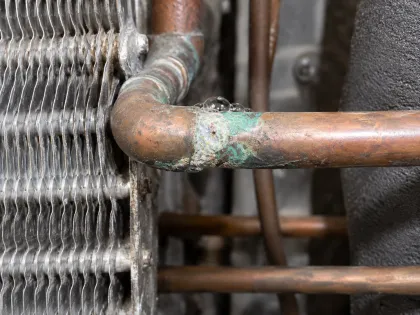
Copper tubes
Organic acids from indoor air can attack copper tubes from the outside and cause pinhole leaks.
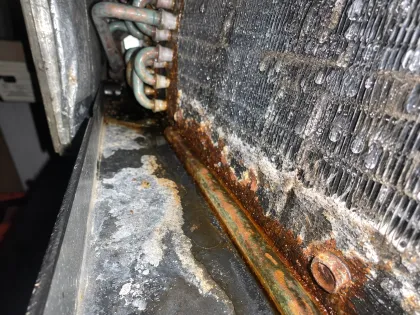
Fin surfaces
Wet fins hold dust and organic matter, which supports microbial growth and traps corrosive deposits.
Illustrative images of typical corrosion at each location
Recommended system by exposure
Starting point for selection. The final specification also depends on fin density, bake limits and target service life.
| Exposure | ISO 9223 | Recommended | Alternative | Why |
|---|---|---|---|---|
| Tropical humid | C3C4 | PG-W | PG-S1 | Thin film keeps condensate draining freely. |
| Coastal fresh-air units | C4C5 | PG-S1 | PG-W | Outdoor air reaches the coil unfiltered for salt. |
| Industrial atmosphere | C4C5 | PG-S1 | PG-C | |
| Wastewater H₂S | C5 | PG-C | — | Sulphide in plant air attacks copper tubes. |
How it is coated
Dip Coating for Finned Heat Exchangers
Full-immersion dip coating for new finned coils — coverage deep in the core and at the fin roots, with film thickness controlled by drain-off.
OEM Contract Coating for Coil Manufacturers
Contract dip and spray coating for coil and unit manufacturers — coating to your specification on partner lines in South China, with batch records.
Pre-Shipment Coil Coating in China
HVAC coils and outdoor units sourced from China, coated on partner lines before loading — coating selected for site corrosivity, with a batch QC report.
Why evaporators corrode indoors
An evaporator coil sits below the dew point of the air it cools, so it is wet for most of its running hours. Any salt, sulphur compound or organic acid in the air dissolves in that water film and stays on the coil.
Fresh-air units are the hardest case. They bring outdoor air — including coastal salt — straight across the coil, with only particle filters in between.
What the coating must not do
An evaporator depends on condensate running off the fins. The coating has to be thin enough not to bridge the fins or hold water, and it must be fully cured so it does not soften under constant moisture.
Related
- CoatingsWaterborne Two-Component Coil Coatings
- EquipmentCopper Tube, Aluminium Fin Coil Protection
- EnvironmentsTropical High-Humidity Environments
- GuidesDoes Coating Cause Fin Bridging on High-Density Fins?
- CoatingsWaterborne Polysiloxane (Sol-Gel) Coil Coating
- EquipmentCondenser Coil Anti-Corrosion Coating
Also see
- EnvironmentsCoastal HVAC Corrosion by Distance from the Sea
- GuidesDoes Coil Coating Reduce Heat Transfer?
- EquipmentCold Room and Refrigeration Evaporator Coating
- EnvironmentsIndustrial Atmospheres (SO₂, NOx, Chlorides)
- GuidesDoes Coating Change Condensate Drainage?
- EnvironmentsFormicary (Ant-Nest) Corrosion in Copper Tubes
- GuidesWhy Do Coil Copper Tubes Develop Pinhole Leaks?
- EnvironmentsIndoor Pool Chloramine Corrosion
- GuidesDo Antimicrobial Coil Coatings Work?

Does coating stop condensate from draining?
A thin, well-drained film does not. Thick films and bridged fins hold water, which is why film thickness and bridging are checked on every batch.
Do evaporators in dry, clean buildings need coating?
Usually not. Coating pays off where the air is humid, salty or polluted, or where the coil treats fresh outdoor air.
Tell us the equipment, the site and the destination port. We reply within 24 hours.