
Heat Pump Coil Protection
Where it corrodes first
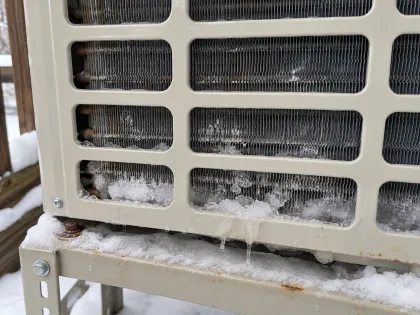
Lower coil rows
Defrost meltwater runs down the coil and can refreeze at the bottom rows, which stay wet longest.
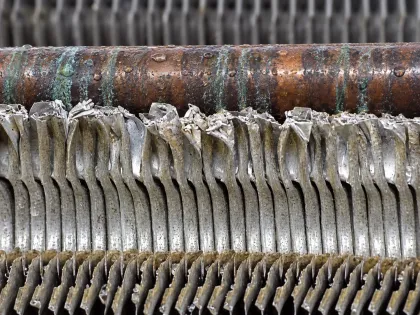
Fin-to-tube joints
Repeated wetting keeps an electrolyte film at every fin collar on copper-tube coils.
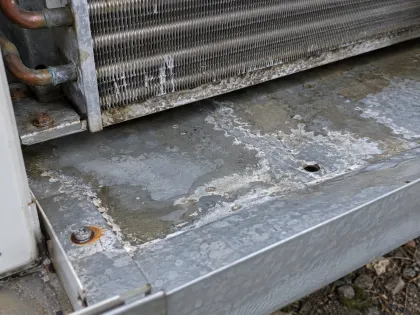
Base pan and drain
Meltwater carries dissolved salt into the base pan, where it concentrates.
Illustrative images of typical corrosion at each location
Recommended system by exposure
Starting point for selection. The final specification also depends on fin density, bake limits and target service life.
| Exposure | ISO 9223 | Recommended | Alternative | Why |
|---|---|---|---|---|
| Coastal | C4C5 | PG-S1 | PG-W | PG-S1 is tested for thermal cycling from −60 °C to 150 °C. |
| Tropical humid | C3C4 | PG-W | PG-S1 | |
| Industrial atmosphere | C4C5 | PG-S1 | PG-C | |
| Complete outdoor unit (cannot be baked) | PG-C | PG-S1 | Air-dry cure; PG-S1 only with ambient moisture cure. |
How it is coated
Dip Coating for Finned Heat Exchangers
Full-immersion dip coating for new finned coils — coverage deep in the core and at the fin roots, with film thickness controlled by drain-off.
Full-Unit Corrosion Protection for Outdoor Units
Complete outdoor units disassembled, masked, coated with an air-dry system, reassembled and function-checked before shipment.
Pre-Shipment Coil Coating in China
HVAC coils and outdoor units sourced from China, coated on partner lines before loading — coating selected for site corrosivity, with a batch QC report.
Two duties, one coil
In cooling mode the outdoor coil is a condenser, hot and dry. In heating mode it is an evaporator, cold and wet, and in cool humid weather it frosts and must defrost regularly. Each defrost wets the coil and then dries it again, leaving any dissolved salt behind on the fins.
What the coating needs
Adhesion and flexibility through temperature swings, full cure so the film does not soften when wet for long periods, and a thin profile that lets meltwater drain. PG-S1 has thermal-cycling data from −60 °C to 150 °C over 100 cycles without cracking.
Related
- CoatingsWaterborne Polysiloxane (Sol-Gel) Coil Coating
- EquipmentCopper Tube, Aluminium Fin Coil Protection
- EnvironmentsCoastal HVAC Corrosion by Distance from the Sea
- GuidesDoes Coil Coating Reduce Heat Transfer?
- CoatingsWaterborne Two-Component Coil Coatings
- EquipmentVRF and Split Outdoor Unit Protection
Also see
- EnvironmentsTropical High-Humidity Environments
- GuidesWhy Do Coil Coatings Fail?
- EquipmentCold Room and Refrigeration Evaporator Coating
- EnvironmentsIndustrial Atmospheres (SO₂, NOx, Chlorides)
- EnvironmentsIndoor Pool Chloramine Corrosion

Does coating slow down defrost?
A thin, fully cured film adds little thermal resistance. What matters more is that the film does not bridge fins and hold meltwater.
Is a heat pump coil harder to protect than a condenser?
Yes, because it is wet far more often and goes through daily temperature cycles. Film adhesion and flexibility matter as much as barrier.
Tell us the equipment, the site and the destination port. We reply within 24 hours.